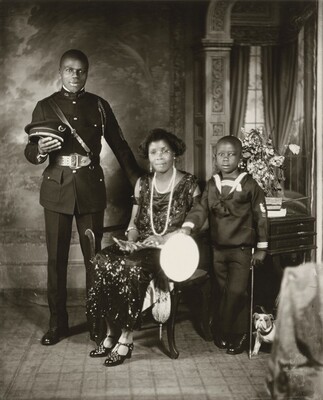
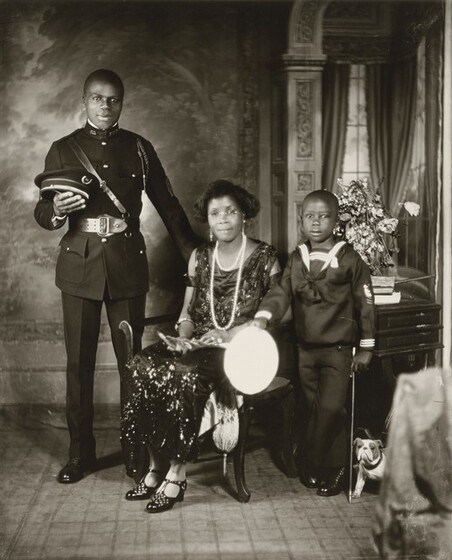
James Van Der Zee, Garveyite Family, Harlem, 1924, printed 1974, gelatin silver impress, Corcoran Drove (Souvenir of Eric R. Play a joke on), 2015.19.4388
How do visual artists of the Harlem Renaissance explore black identity and political empowerment?
How does visual art of the Harlem Renaissance relate to current-24-hour interval events and issues?
How practice migration and deportation influence cultural production?
"I believe that the [African American's] advantages and opportunities are greater in Harlem than in any other identify in the country, and that Harlem volition become the intellectual, the cultural and the financial center for Negroes of the United States and will exert a vital influence upon all Negro peoples." —James Weldon Johnson, "Harlem: The Culture Capital," 1925
The Harlem Renaissance was a period of rich cross-disciplinary creative and cultural activity amidst African Americans between the end of World War I (1917) and the onset of the Keen Depression and lead up to World War Two (the 1930s). Artists associated with the motion asserted pride in black life and identity, a ascent consciousness of inequality and discrimination, and interest in the rapidly irresolute modern world—many experiencing a liberty of expression through the arts for the get-go time.
While the Harlem Renaissance may be best known for its literary and performing arts—pioneering figures such as Langston Hughes, Zora Neale Hurston, Duke Ellington, and Ma Rainey may be familiar—sculptors, painters, and printmakers were central contributors to the outset modern Afrocentric cultural move and formed a black advanced in the visual arts.
Aaron Douglas (1899–1979) is known as the "father of African American art." He defined a modern visual language that represented black Americans in a new light. Douglas began his artistic career as a landscape painter but was influenced by modern fine art movements such every bit cubism, in which subjects appear fragmented and fractured, and by the graphic arts, which typically use bold colors and stylized forms. He and other artists also looked toward West Africa for inspiration, making personal connections to the stylized masks and sculpture from Benin, Congo, and Senegal, which they viewed as a link to their African heritage. They also turned to the art of artifact, such equally Egyptian sculptural reliefs, of popular involvement due to the 1922 discovery of Male monarch Tutankhamen's tomb. Printmakers James Lesesne Wells (1902–1993) and Hale Woodruff (1900–1980) also explored a streamlined approach that drew from African and European creative influences.
Sculptor Richmond Barthé (1901–1989) worked in a realistic mode, representing his subjects in a nuanced and sympathetic light in which black Americans had seldom been depicted before. Painter Archibald John Motley Jr. (1891–1981) began his career during the 1920s as 1 of the first African American graduates of the Schoolhouse of the Fine art Institute of Chicago. In the early part of his career, he created intimate and direct portraits, such as Portrait of My Grandmother of 1922.
James Van Der Zee (1886–1983), a photographer, became the unofficial chronicler of African American life in Harlem. Whether through formal, posed family photographs in his studio or through photo essays of Harlem's cabarets, restaurants, barbershops, and church services, his large body of work documents a growing, diverse, and thriving community.
The formation of new African American artistic communities was engendered in part past the Great Migration—the largest resettlement of Americans in the history of the continental Us, mainly from rural Southern regions to more populous urban centers in the Northward. Pursuit of jobs, better education, and housing—besides as escape from Jim Crow laws and a life constrained past institutionalized racism—drove black Americans to relocate.
The onset of the Slap-up Low in 1929 deflated the artistic energy of the period equally many people became unemployed and focused on meeting basic needs. Yet the Harlem Renaissance planted artistic seeds that would germinate for decades. Many of the visual artists associated with the Harlem Renaissance came to participate in the Federal Art Projection (1935–1943), an employment program for artists sponsored by President Franklin Delano Roosevelt's Works Progress Administration. Further, a key legacy of the Harlem Renaissance was the cosmos of the Harlem Community Art Centre (HCAC) in 1937, office of a cross-state network of arts centers. The HCAC offered easily-on art making led by professional artists and maintained a printmaking workshop. The HCAC was disquisitional in providing black artists continued support and training that helped sustain the next generation of artists to sally after the war. In subsequent decades, the Harlem Renaissance inspired new waves of artists and laid critical background for the civil rights motility and the Black Arts Movement.
Every bit a concluding note, women artists were also part of the Harlem Renaissance and participated peculiarly as singers, actors, dancers, and writers. Less well-known are the women visual artists of the catamenia. Gaining access to the visual arts scene was more hard than entry into the performing arts, as the practise of painting and sculpture in particular were non considered gender-appropriate or "feminine." Two sculptors, Meta Vaux Warrick Fuller (1877–1968) and Augusta Savage (1892–1962), the latter an activist, artist, and director of the HCAC, made their mark during the catamenia, simply their work has been largely overlooked and is but coming into full assessment by fine art historians today.

Harlem Renaissance James Weldon Johnson,God's Trombones: 7 Negro Sermons in Poetry, 1927
Ii artists collaborated on this famous Harlem Renaissance–era book, which combines interpretations of biblical parables written in contemporary verse with assuming illustrations that echo the power and symbolism of the words.
The writer James Weldon Johnson, author, poet, essayist, and chronicler of Black Manhattan (the title of one of his books), commissioned Aaron Douglas to illustrate God's Trombones. The book is organized into eight chapters: an explanatory preface by Johnson and introductory prayer followed by seven sermon-poems entitled "The Creation," "The Dissipated Son," "Go Downwardly Death—A Funeral Sermon," "Noah Built the Ark," "The Crucifixion," "Let My People Go," and "The Judgment Twenty-four hours." Each sermon adopts the vernacular of an African American preacher and is accompanied by dynamic, black-and-white illustrations that bandage the stories in a gimmicky light and feature black protagonists. Douglas's painting way used bold coloration, merely printing processes of the 1920s made colour illustrations hard and costly, which is why the illustrations are monochrome with text offset in a single color.
Learn more about this work hither

Harlem Renaissance Aaron Douglas,The Judgment Day, 1939, oil on tempered hardboard, Patrons' Permanent Fund, The Avalon Fund, 2014.135.1
Years after the 1927 publication of God's Trombones: Seven Negro Sermons in Verse, Aaron Douglas painted new works of art based on his original illustrations for the book. The creative person's use of complementary colors (purple and yellow/greenish) combined with overlapping arcs, zigzagging shapes, and the silhouetted figures' extended limbs create an energized limerick. The central figure, who is outsize to show his importance (a device used in ancient Egyptian art, which was an influence on Douglas'southward manner) represents Gabriel, an archangel appearing in the Old and New Testaments of the Bible who serves equally God's messenger and whose name means "God is my strength." The other figures answer to Gabriel's call and the pulsating forms suggest the trumpet's echoing sound. The poetry that accompanied the illustration published in God's Trombones likens Gabriel to a blues trumpeter:
And Gabriel's going to ask him: Lord,
How long must I blow information technology?
And God's a-going to tell him: Gabriel,
Blow information technology calm and piece of cake.
Then putting ane pes on the mountain peak,
And the other in the middle of the ocean,
Gabriel's going to stand and accident his horn.
To wake the living nations.
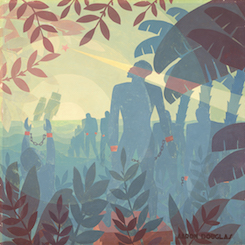
Harlem Renaissance Aaron Douglas,Into Chains, 1936, oil on canvas, Corcoran Collection (Museum Purchase and partial gift from Thurlow Evans Tibbs, Jr., The Evans-Tibbs Collection), 2014.79.17
This painting refers to the Atlantic slave merchandise, during which 10–12 million people were trafficked from Africa to the Americas, most during the period from the 1600s to the 1800s. The U.s.a. outlawed farther slave trade into the country in 1808, although the practise itself was not abolished until 1864. The painting positions u.s. as viewers behind a scrim of leaf, as if we are hiding or witnessing the scene. There is a receding line of male figures, heads bowed, advancing toward the ocean and approaching ships that volition forcibly ship them to a foreign place and life of enslavement. Aaron Douglas uses nonnaturalistic, complementary colors—teal-blue figures and a searing, lemon-xanthous sky—to add drama. Wrist shackles are painted a contrasting orangish, which draws our eye to them. Ane effigy has dropped to his knees in the foreground, artillery raised beseechingly heavenward, while a central standing figure gazes at a single star whose beam of lite illuminates him, mayhap a reminder that he is not forsaken.

Harlem Renaissance Fritz Winold Reiss,Untitled (2 Figures in an Incline), woodcut, Reba and Dave Williams Collection, Gift of Reba and Dave Williams, 2008.115.4080
Fritz Winold Reiss and his family emigrated from Germany to the United States in 1913. He traveled extensively around the U.s. and United mexican states, and became interested in America's racial diverseness, frequently portraying ethnic Americans and African Americans. Reiss illustrated The New Negro, Alain Locke'due south influential anthology of writing, thought, and poetry that became an emblem of the Harlem Renaissance. Published in 1925, The New Negro asserted the unique qualities of black American culture and life and encouraged ownership and pride in its art and heritage.
Reiss, who was white, was inspired by the same sources as black artists and designers: modern European art and the stylized forms of African art, including ancient Egyptian art (see the related Pinterest lath for examples). Here, the figures, shown only in contour, are compressed into a geometrical space throbbing with agile lines and movement. One figure appears to tend the hair of another, while the multiply breasted effigy could exist a goddess or symbol of fertility. Reiss'due south active composition of jagged lines and radiating forms influenced Aaron Douglas.

Harlem Renaissance James Lesesne Wells,Looking Upwards, 1928, woodcut in blackness on laid paper, Ruth and Jacob Kainen Collection, 1994.87.ix
James Lesesne Wells found inspiration in the stylized qualities of African sculpture and in German expressionist art, which revived the centuries-old medium of woodcut printing for the modern age. This piece of work shows an outsize, silhouetted figure making his way amid, and dominating, an urban woods of skyscrapers that seem to tumble in his wake. He appears to carry a minor model of other dwellings, peradventure a representation of home or the idea of home we retain in retentiveness. The figure looks almost him, as if seeking or aspiring to fit in or establish roots. Many African Americans elected to move from the South to Northern cities during the Corking Migration, experiencing both displacement and aligning to new urban environments.

Harlem Renaissance Richmond Barthé,Caput of a Boy, c. 1930, painted plaster, Corcoran Collection (The Evans-Tibbs Drove, Gift of Thurlow Evans Tibbs, Jr.), 2014.136.295
Richmond Barthé sculpted African American subjects in a sensitive, realist fashion. Barthé followed a classical style in sculpture, assertive that any subject could be dignified and cute if rendered with skill and thoughtfulness. Up until the Harlem Renaissance, African American faces rarely appeared as the central subject of visual art. Barthé'southward fine art and interest in the male figure was informed by his identity as a gay human, who according to the times was constrained in disclosing this part of his life openly, although he did find fellowship and beloved interests among the period's artists and intellectuals.
Barthé grew up in New Orleans and headed north with the support of his family to pursue an artistic teaching at the School of the Art Found of Chicago (SAIC), where he studied painting. At the time, SAIC and the Pennsylvania Academy of the Fine Arts were the two US art schools that admitted African American students. Barthé discovered his talent for sculpture in 1927, when he was introduced to the medium during a class consignment to create a portrait bosom of a boyfriend student in clay (he completed two). These initial works were noticed by the teacher and included in an exhibition, The Negro in Art Calendar week, launching Barthé's career and lifelong commitment to sculpture.

Harlem Renaissance Werner Drewes,Harlem Beauty, 1930, woodcut in black, Ailsa Mellon Bruce Fund, 1974.84.1
In 1930, Werner Drewes emigrated to New York City from Frg, where he had been an fine art educatee. This work is from the same year he arrived in New York and pays homage to African American womanhood and beauty. The image, created by a white creative person who worked in circles outside of Harlem, attests to the widespread cultural impact of the Harlem Renaissance, of interest to people across racial and social lines, including artists, teachers, patrons, and funders who engaged in pluralist, interracial dialogues. Drewes occasionally made images of people and scenes in Harlem and other New York locations. Harlem Beauty has a timeless and sculptural quality, with its stripped-down focus on the woman's illuminated face in profile, a classical portrait mode. Drewes, like Fritz Winold Reiss, was associated with a modernist European tradition that likewise was of interest to many African American artists during the Harlem Renaissance. Tin can you retrieve of other examples of cultural dialogue, wherein seemingly distinct populations influence each other's artistic practices?
Drewes worked in President Franklin Delano Roosevelt's Works Progress Administration (WPA) artist employment programs as an art teacher at the Brooklyn Museum and Columbia University. He later headed the graphic arts partitioning of the Federal Fine art Projection, part of the WPA, in New York state. He was a prolific printmaker and, later, painter.
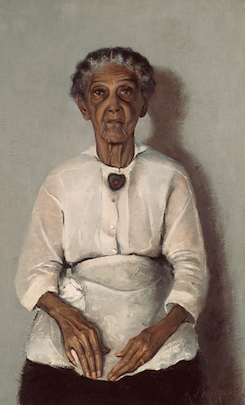
Harlem Renaissance Archibald John Motley Jr.,Portrait of My Grandmother, 1922, oil on sheet, Patrons' Permanent Fund, Avalon Fund, and Motley Fund, 2018.2.1
The extended Motley family moved from New Orleans to Chicago in 1894. The grouping included the artist'due south paternal grandmother, Emily Motley, pictured hither. Her son, Archibald Motley Sr., worked as a Pullman porter on the Michigan Central Railroad and his wife, Mary 50. Motley, was a schoolteacher. Their professions were among the highest-status and best-paying jobs black Americans could hold at the time and situated the family unit in the middle course. The family's move predictable the northward Great Migration of African Americans that gained momentum during Globe War I and connected until the ceremonious rights era.
The artist was amid the first African Americans to attend the School of the Art Found of Chicago (from 1914 to 1918), where he as well worked equally a janitor to defray costs. Following graduation, Motley elected to focus his art on themes around blackness American life. This portrait of his grandmother, who was born into slavery in Kentucky in 1842, is venerable and dignified, the effects of time and hard piece of work visible on her hands and face. She lived until historic period 87. The work, completed when Motley was yet an unknown, may have been painted on a bandage-off Central Railroad laundry pocketbook from his father'due south railroad train line.
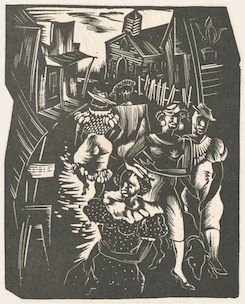
Harlem Renaissance Unhurt Woodruff, Robert Blackburn,Sunday Promenade, published 1996, linocut in black with chine-collé on wove paper, Corcoran Collection (Gift of E. Thomas Williams, Jr. and Auldlyn Higgins Williams in retention of Thurlow Evans Tibbs, Jr.), 2015.19.3032.viii
Hale Woodruff, alongside Aaron Douglas, Richmond Barthé, and Archibald John Motley Jr., is amid the major visual artists of the Harlem Renaissance. Robert Blackburn, an African American artist also credited for this work, founded the Printmaking Workshop in New York, where he taught lithography and printed editions for artists, such as this one. All of the same artists were born and lived exterior New York, but ultimately relocated to Harlem, drawn by its magnetic fine art scene. In so doing, they joined many African Americans in the northward exodus that became known as the Great Migration. Woodruff studied fine art at Harvard University and at the School of the Art Institute of Chicago, as well as working in Paris, where he embraced modern styles of painting. In improver, he studied with Mexican muralist Diego Rivera, whom he admired for the social justice themes he pursued in his art.
Sunday Promenade, part of a serial of work Woodruff made while living in Atlanta during the Depression, depicts two couples and a woman wearing their Sunday best. A church lies backside them in a bespeak at the peak of the composition and underscores the centrality of spiritual life in the African American community. The turned-out appearance of the promenaders contrasts with the modest wooden structures also pictured. Woodruff also made politically charged piece of work that dealt graphically with lynching, an issue he felt compelled to confront with his art. During the first office of the 20th century, the NAACP and other groups worked to accelerate anti-lynching legislation, which was never passed.
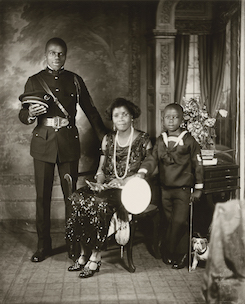
Harlem Renaissance James Van Der Zee,Garveyite Family, Harlem, 1924, gelatin silver print, printed 1974, Corcoran Collection (Gift of Eric R. Trick), 2015.19.4388
James Van Der Zee opened the Guarantee Portrait Studio in Harlem in 1917. He captured the faces and lives of people who lived in Harlem: its famous entertainers, artists, leaders, and a growing blackness middle class. He besides took his camera to the places they chosen their ain: homes, billiard halls, barbershops, churches, and clubs. Van Der Zee'due south work forms an important relate of black life of the flow. This well-dressed family was associated with Marcus Garvey's move, the Universal Negro Comeback Association (UNIA). UNIA advocated for blackness Americans (and others from the African diaspora) to emigrate to Africa to populate and further develop Liberia, the only not-colonial state on the continent. Van Der Zee was hired by the UNIA to record and certificate its marches, parades, and members, who adopted a quasi-militaristic appearance. The UNIA became a mass movement of over 200,000 members during the 1920s, a time when the Ku Klux Klan had reemerged as a white nationalist group. Garvey was convicted of mail service fraud in 1927 and deported to his native Jamaica. Absent his leadership, the movement faded.

Harlem Renaissance James Van Der Zee,Alpha Phi Alpha Basketball game Team, 1926, gelatin silver print, Corcoran Collection (The Evans-Tibbs Drove, Souvenir of Thurlow Evans Tibbs, Jr.), 2015.19.4507
This portrait of a college basketball team shows a serious group of young men united by their affiliation with their fraternity and its basketball team. Alpha Phi Alpha was the first intercollegiate African American fraternity in the United States, its starting time affiliate founded in 1906 at Cornell Academy in Ithaca, New York. The fraternity provided support, written report groups, and, subsequently, opportunities to participate in intercollegiate sports at a time when blackness players were not permitted on college teams. Note how each role player is carefully posed and forms a symmetrical arrangement on the steps of the fraternity, showing their integrity as a group while radiating their determination to succeed in a racially divided land.

Harlem Renaissance Norman Lewis,Jazz, c. 1938, lithograph in black on wove paper, Reba and Dave Williams Collection, Florian Carr Fund and Gift of the Print Research Foundation, 2008.115.193
Similar Aaron Douglas, Norman Lewis was attuned to the importance of jazz and blues music, especially growing up in Harlem during the heyday of the Harlem Renaissance. Simply 19 when he created this impress, the work shows a modern, abstract quality while capturing visually the sense of music produced by this quartet of musicians, who seem to bob in the space of the picture, emulating the rhythm of the music.
Lewis was influenced by the writings of Alain Locke, an intellectual, impresario, and leader of the Harlem Renaissance who advocated for black visual artists to explore the distinctive grapheme of their experience and culture. Jazz is a hybrid art form with many influences, including West African music. In 1935, Lewis viewed African Negro Fine art, an early American exhibition (at the Museum of Modern Fine art, New York) of African sculpture, textiles, and objects shown equally aesthetic works of art rather than ethnographic artifacts. Lewis and so began a phase of drawing imagined African masks (see the associated Pinterest board for an example). The masklike appearance of the figures in this piece of work may too accept been influenced past the exhibition.
Lewis's printmaking activeness over the course of his career was limited; he made prints for the Works Progress Administration's Federal Art Projection (FAP) during the Depression years and several editions independently in the 1940s, subsequently which he returned to printmaking only sporadically. After the 1940s, Lewis embraced abstraction in his fine art and became well-known in the 1950s and across for his big-calibration paintings, one of which is besides in the National Gallery of Art drove (see the related Pinterest board). He is also notable among the artists who took office in the FAP—as printmakers, muralists, and teachers—who subsequently became prominent abstruse artists, including Jackson Pollock, Willem de Kooning, and Jacob Lawrence.

Harlem Renaissance Isac Friedlander,Rhapsody in Black, 1931, wood engraving, Reba and Dave Williams Collection, Gift of Reba and Dave Williams, 2008.115.1943
Isac Friedlander, a white printmaker who emigrated to the Us in 1929, reminds us that the Harlem Renaissance and its exuberant nightlife was likewise an attraction for progressive-minded whites who traveled to Harlem to partake of the entertainment, which was more often than not entirely produced, written, and performed by black artists and impresarios. Hither a superlative-hatted bandleader leads a group of robed singers, a jazz orchestra, and a pianist in a vibrant musical event. The technique of forest engraving that Friedlander used is a process in which the artist uses negative, or white, lines to draw the image (think of drawing on a blackness scratchboard). The technique can produce nuanced detail due to the very fine-grained woods that is used for the process. The nature of the medium allowed Friedlander to capture the feeling of a night nightclub with the performers' faces illuminated by phase lights. This dynamic scene may take been captured by Friedlander prior to the onset of the Depression.

Harlem Renaissance Alfred Stieglitz,Brancusi Exhibition at 291, 1914, printed 1924/1937, gelatin silver print, Alfred Stieglitz Collection, 1949.3.353
This is an image that documents a 1914 gallery exhibition of sculptures by Constantin Brancusi, a Romanian modernist who worked in Paris and was greatly influenced by the forms of African fine art. At this time, West African art was being imported to the United States by French and Belgian fine art dealers. This art had come to the attending and interest of artists working in Paris at the kickoff of the 20th century, including Pablo Picasso, Henri Matisse, Paul Gauguin, Amedeo Modigliani, Brancusi, and others, who were searching for new forms to express the modern era and a new century. They plant inspiration in the oft abstract and stylized forms of African art, also as the art of other non-Western cultures and of antiquity. The relationship of Europeans to the art of Africa entails a complex dynamic that raises questions almost who has the correct to appropriate and interpret another civilisation's patrimony. A generation after the Parisian modernists, the artists of the Harlem Renaissance also borrowed from the forms of African art every bit a means of reconnecting with and expressing pride in their African heritage.
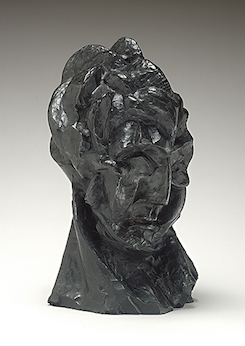
Harlem Renaissance Pablo Picasso,Head of a Woman (Fernande), model 1909, cast before 1932, bronze, Patrons' Permanent Fund and Souvenir of Mitchell P. Rales, 2002.one.1
Many Europeans assimilated influences from African art, including Spanish creative person Pablo Picasso, who often worked in Paris
At left, the modeled and bandage caput of Picasso's companion, Fernande Olivier, is in a cubist mode. Cubism shattered ideas of how space and objects could be depicted in art. For the first time, art was not trying to reproduce the appearance of a person or object. Instead, objects and the subjects of portraits, like this i, were fractured into smaller planes and surfaces. Cubism was meant to portray the artist's way of seeing and perceiving the bailiwick. Modern artist David Hockney has noted, "Cubism was an assault on the perspective that had been known and used for 500 years. Information technology was the offset big, big change. It confused people: they said, 'Things don't look like that!'" Some of Picasso's inspiration for cubism derived from his interest in African fine art, and specially masks, which he collected and kept in his studio in Paris.

Harlem Renaissance Amedeo Modigliani,Head of a Adult female, 1910/1911, limestone, Chester Dale Drove, 1963.10.241
Amedeo Modigliani, an artist from Italy, too worked in Paris, a vibrant cultural capital that attracted young artists from all over Europe. His piece of work does not embrace cubism, but he abstracted the features of his Head of a Woman by elongating them, mayhap in emulation of African masks or archaic sculpture. In turn, artists of later generations, such as those of the Harlem Renaissance, became interested in both the values of modernistic art, which rejected the fine art styles and traditions of the past, and in African art, which developed along a distinct trajectory independent of Europe.

Harlem Renaissance Walker Evans,Figure of a Woman, Laongo, 1935, gelatin silver print, Gift of Samuel and Marilyn Stern, 1991.119.17
This work of art was among some 600 presented in a 1935 exhibition at the Museum of Modern Art, New York, entitled African Negro Art. The exhibition marked the first fourth dimension that non-Western cultural objects were shown in a modern art gallery as aesthetic art objects rather than ethnographic artifacts. In and so doing, the museum acknowledged the significant influence of African art, traded from colonized African countries, on Western modernistic art.

Harlem Renaissance Walker Evans,Polychrome Mask, 1935, gelatin silver print, Gift of Samuel and Marilyn Stern, 1991.119.vi
In 1935, the Museum of Modern Art in New York presented the exhibition African Negro Art. The exhibition's emphasis on the objects' aesthetic qualities led the museum to omit data about their cultural context and ceremonial use or significance, which prevented visitors from accessing a deeper understanding of the objects' origins. For example, the championship of this mask does not offer cultural information, such as the fact that it is from Gabon or the Congo-brazzaville, Kwele people. What tin you notice about art from West Africa and its characteristics?
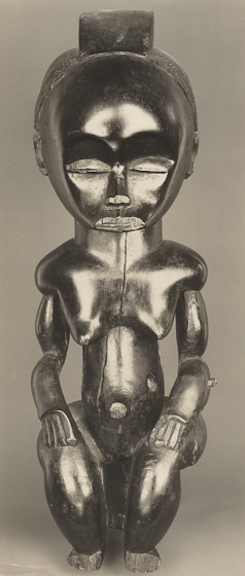
Harlem Renaissance Walker Evans,Figure of a Young Adult female, Pahouin, Border of Spanish Guinea, 1935, gelatin silvery impress, Gift of Samuel and Marilyn Stern, 1991.119.10
Today, the Pahouin civilization referred to in this object'south title is more commonly known as Fang or Fãn, a Central African ethnic group.
The Museum of Modern Art's 1935 exhibition, African Negro Fine art, was photographed by Walker Evans, who may exist best known for his photography documenting the effects of the Depression in rural America. Evans produced a portfolio containing 477 prints of African Negro Art; most of these sets were given to African American colleges and universities in the United States.
0 Response to "Portrait of Singing Dancing and Art of African American Culture"
Post a Comment